The Faraglioni and their arch, the Green and White grottoes, Villa Malaparte, the Natural Arch and Punta Carena — in the order the boats pass them.
Capri keeps its best secrets at sea level. You can spend a full day ashore — the funicular to the Piazzetta, the shops of Capri town, the chairlift up Monte Solaro — and still miss the sculpted grottoes, the tunnel through the Faraglioni, the blood-red house on the cliff and the wild western coastline that made the island famous. These sights face outward, toward the water, and most cannot be reached or properly seen on foot.
Check live availability — full island circuit from Sorrento with Blue Grotto attempt
This guide walks through a circumnavigation of the island sight by sight, in roughly the order the boats pass them, with the practical detail that decides whether you'll actually see each one. It's pre-trip reading rather than a sales pitch — for the tour formats and prices themselves, see our Capri boat tours from Sorrento guide, and for the cave everyone asks about, the Blue Grotto guide.
The Circumnavigation at a Glance
Capri is small: the classic island loop covers roughly 17 km of coastline and takes about 90 minutes to sail without stops, or around two hours with photo pauses and a swim. Almost all group tours leave from Marina Grande, the island's main port, and most run counterclockwise — heading east first — though private skippers sometimes reverse the direction to chase the best light. Tours arriving from Sorrento join the same loop after the ~30-minute crossing.
Heading east from Marina Grande, the standard order of sights is:
Punta del Capo with the bronze Scugnizzo statue, on the northeast headland
Salto di Tiberio — the sheer cliff below Villa Jovis
Grotta del Bove Marino and the caves of the Matermania cove
Grotta Bianca (White Grotto) and, below it, the Grotta Meravigliosa
Villa Malaparte, the red modernist house on Punta Massullo
The Natural Arch, high on the eastern cliffs
The Faraglioni — where boats pass through the middle stack's arch
Marina Piccola, the sheltered southern bay and a common swim stop
Grotta Verde (Green Grotto) on the south coast
Punta Carena lighthouse at the southwestern tip
The wild western and northern coast, past the Blue Grotto
Bagni di Tiberio, Roman ruins and a beach club just before the port
The one wild card: the Blue Grotto stop. Entry depends on sea conditions and queues and is never guaranteed — many "island tour + Blue Grotto" tickets simply skip the stop when the wait passes 45 minutes, and in high season that wait can reach two hours. Treat it as a bonus, not the reason you booked.
The Faraglioni Rocks
If Capri has a single symbol, it's the Faraglioni — three limestone towers rising from the sea off the island's southeastern tip, at the foot of the Tragara headland. Eroded out of the coastline over millennia, they've been treated as natural monuments since tourism arrived here in the 19th century. The name most likely comes from the Greek pháros, lighthouse: in antiquity, coastal rocks like these carried signal fires for sailors.
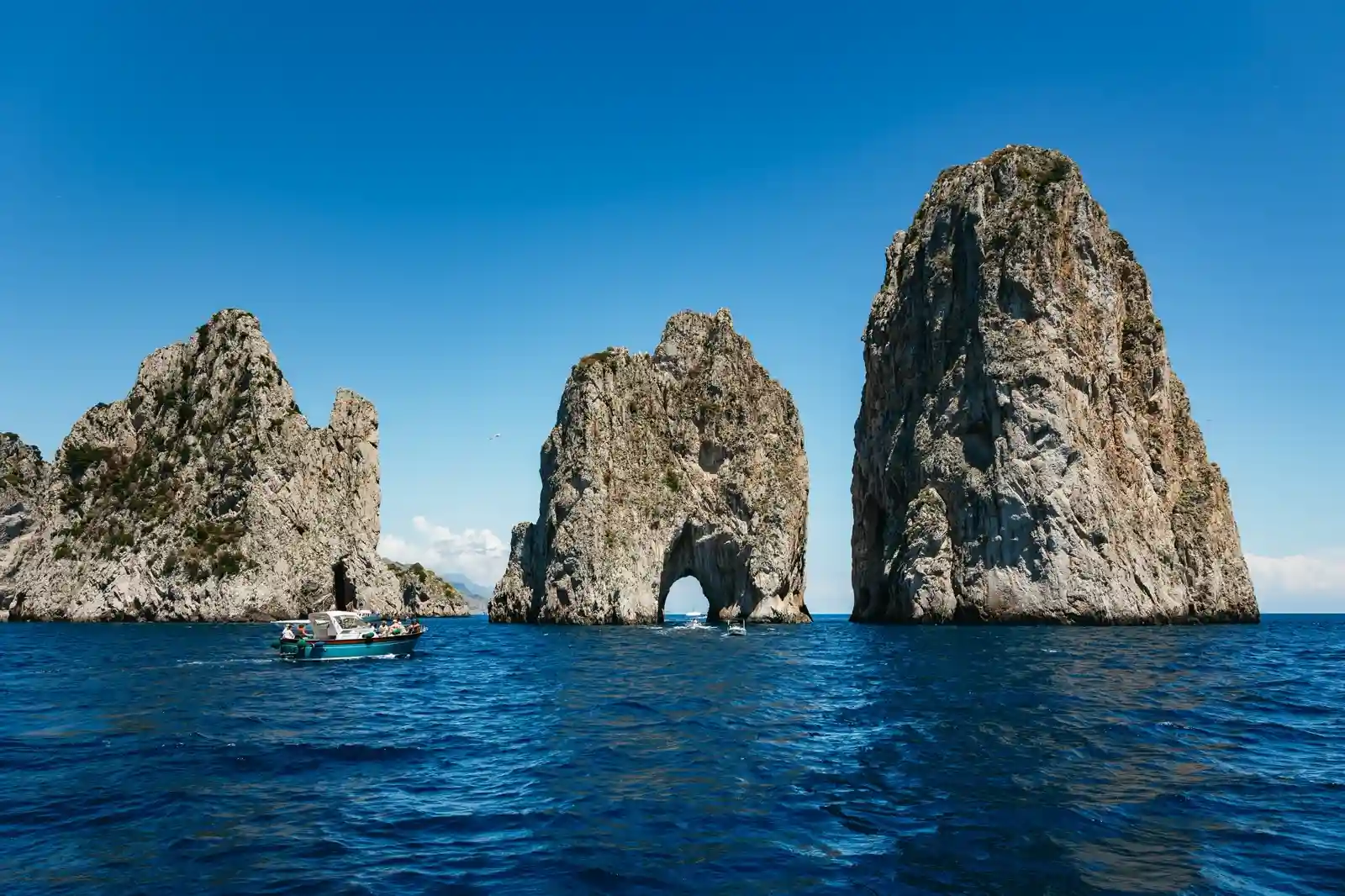
The three stacks from the water — the only angle that gives you their true scale.
The three stacks
Faraglione di Terra (also called Stella) — the tallest at 109 m, and the only one still joined to the island by a thin isthmus of rock.
Faraglione di Mezzo — the middle stack, 82 m, pierced by the famous natural archway. It's the smallest of the three but the star of every tour: boats sail right through the tunnel at its base.
Faraglione di Fuori (Scopolo) — the outermost, 106 m, and the only home in the world of the blue lizard.
A fourth rock, the Scoglio del Monacone, sits just beyond and is sometimes counted as a fourth faraglione. Its name probably derives from the monk seal (monaco), sighted in Capri's waters until the early 20th century, though some studies link it instead to the tomb of Masgaba, architect to the Emperor Augustus.
The blue lizard
Scopolo is home to Podarcis siculus coeruleus, a subspecies of the common Italian wall lizard that has evolved an intense cobalt-blue colouring — most vivid on the males — thought to camouflage it against sea and sky on a bare, waterless rock. It was first described by the German zoologist Theodor Eimer in 1872, and researchers from the University of Naples Federico II, working with climbers to reach the stack, have suggested the blue arrived almost accidentally, dragged along with other traits of extreme island adaptation. You won't spot it from a passing boat, but it's why a bare pinnacle of rock has scientific fame.
Kissing under the arch
The most-repeated tradition of any Capri boat tour happens as you pass through the arch of the Faraglione di Mezzo: local lore holds that couples who kiss as they sail beneath it are blessed with lasting love — some versions promise good luck, fertility, or thirty years of happiness. Skippers make a ceremony of it, and most spin the boat so everyone gets the photo. Boats pass through whenever conditions allow; in a swell or strong wind the passage becomes unsafe and skippers go around the outside instead.
Where the views are best
The Faraglioni face south and catch sun all day, so there's no bad time — but the angle changes everything. From the water is the only way to grasp their scale and to sail through the arch, and the deep blue-green of the sea becomes the dominant element. From land, the classic elevated views are from the Gardens of Augustus, the Belvedere di Tragara at the top of Via Tragara, and — for the widest panorama — the summit of Monte Solaro above Anacapri; Punta Cannone is the quieter alternative on busy days. Early morning and late afternoon bring softer light and thinner crowds.
The island loop is the centrepiece, but there's more to build a day around. Boat tours to Capri run from Sorrento, Positano, Amalfi and Naples, and once ashore at Marina Grande the funicular climbs to the Piazzetta for the Gardens of Augustus, Via Krupp and Belvedere di Tragara, or the bus runs on to Anacapri and the Monte Solaro chairlift.
On the water, the popular add-ons are Blue Grotto visits, snorkelling and swim stops around Marina Piccola and the Green Grotto, private charters and sunset cruises along the Amalfi Coast. Browse live options below.
Capri's Sea Caves Beyond the Blue Grotto
Everyone has heard of the Blue Grotto, where sunlight entering through an underwater opening turns the water electric blue. But Capri is a limestone island riddled with sea caves, and a full circumnavigation reveals a string of lesser-known ones that are, in their own way, just as memorable. Crucially — unlike the Blue Grotto, where swimming is forbidden and entry costs €18 per person in 2026 (€12 of it the rowboat transfer; EU citizens aged 18–25 pay €14, under-6s free) on top of a long queue — several of these are free to pass and some let you swim.
Green Grotto (Grotta Verde)
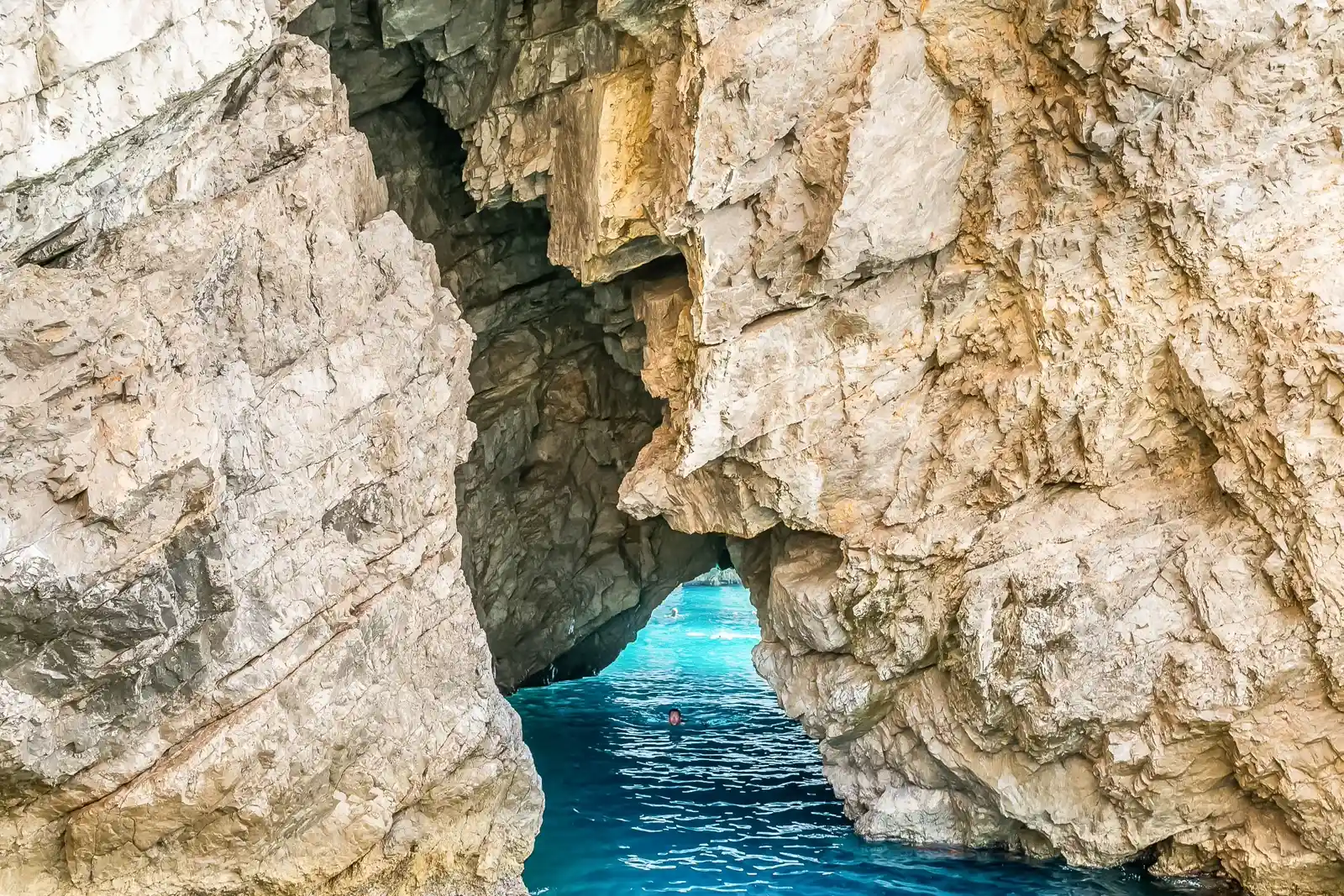
The highlight of the southern coast, just past Marina Piccola. It's named for the way sunlight filtering through two underwater passages refracts off a white sandy seabed, turning the water an emerald green that shifts from pale blue to deep jade with the sun. Historically it was also known as the Grotta dei Turchi, from a tradition that Saracen pirates used it as a hiding place. It's accessible only by boat, and unlike the Blue Grotto its entrance is wide enough that many tours let passengers swim inside — which is why it appears on so many "blue and green grotto" itineraries. Three interconnected caves nicknamed the "Three Sisters" sit beside its western access, reachable by swimming for the confident.
White Grotto (Grotta Bianca)
On the eastern coast near the Matermania cove, the White Grotto opens about 20 m above the sea. It's named for the pale limestone deposits whitening its walls and vault and for the stalactites inside — one formation is said to resemble a Madonna, and the upper chamber holding it is called the Grotta Meravigliosa. The entrance is roughly 15 m wide and the interior runs over 50 m. The lower level is reached by boat; the upper shelves need a short swim to a stone ladder, first cut in 1901 by two British travellers, Maund and Kennedy. Most tours view it from just outside or below.
Coral Grotto and the rest
The Coral Grotto (Grotta del Corallo), also called the Grotta Rossa, takes its name from the purple-red corallo caprese and sea anemones tinting its walls, with vivid blue water inside — a common quick stop on tours from Sorrento. Beyond these, skippers point out the Grotta dei Marinai near the Faraglioni, the Grotta della Fenestrella lit by an opening in its roof, and the Grotta del Bove Marino, which "moos" when the swell surges into it. Along the wild ridge toward Punta Carena, skippers keep a respectful distance from the cliffs because of falling rocks.
Cave
Coast
Can you swim?
Cost
Blue Grotto
Northwest
No — strictly forbidden
€18 cash, weather permitting
Green Grotto
South
Usually yes, tour permitting
Free to pass
White Grotto
East
Viewed from outside; short swim on some tours
Free to pass
Coral Grotto
South/west
Usually viewed from outside
Free to pass
Villa Malaparte
Rounding onto the southeastern coast, one sight stops every boat: a long, low, blood-red house alone on the rocky promontory of Punta Massullo, 32 m above the sea, with a huge trapezoidal staircase rising to a bare rooftop terrace. This is Casa Malaparte, one of the most celebrated houses of 20th-century architecture.
It was conceived around 1937–38 for the writer and provocateur Curzio Malaparte (1898–1957). The Rationalist architect Adalberto Libera produced the initial design, but the two men clashed; Malaparte rejected the scheme and effectively built the house himself with a local stonemason, Adolfo Amitrano, working to his own vision. The result — built roughly 1938–1942 from local stone, with materials hauled in by mule — is a paradox: rigorously modern yet archaic, and so bound up with its owner that authorship is still debated. Malaparte called it "a house like me."
Its global fame was sealed by cinema: Jean-Luc Godard filmed Le Mépris (Contempt) here in 1963 with Brigitte Bardot and Michel Piccoli, making the rooftop staircase unforgettable. Fashion campaigns and a Jacquemus runway show followed. After Malaparte's death the house fell into disrepair and was restored from the late 1980s by his great-nephew; it remains in the family's hands.
Villa Malaparte is not open to the public — access is by private invitation only. For virtually every visitor the water is the only way to see it, which makes it one of the strongest arguments for taking a boat tour at all.
The Natural Arch & the Eastern Coastline
The eastern side of Capri is its wildest and most dramatic, and it's dense with sights.
The Natural Arch (Arco Naturale)
High on the eastern cliffs stands a limestone arch about 12 m wide and 18 m high, some 200 m above the sea. Dating from the Paleolithic era, it's the last surviving fragment of a great collapsed grotto sculpted by wind and water. From the boat you see it as a distant window in the cliff face; to reach it on foot you walk about 1.3 km east from the Piazzetta down Via Matermania. Below it at the shoreline sits the Grotta di Matermania, a large cave the Romans converted into a nymphaeum decorated with mosaics and stucco — visible from the water.
Salto di Tiberio
On the northeast corner, a sheer precipice drops roughly 297 m to the sea below the ruins of Villa Jovis, the largest of the twelve villas the Emperor Tiberius built on Capri, completed in AD 27. A legend recorded by Suetonius has Tiberius hurling condemned enemies from this cliff, to be finished off by sailors waiting below with oars and poles. Historians treat the tale with heavy scepticism — the 19th-century writer Maxime Du Camp even demonstrated that objects thrown from the top strike the rocks before reaching the water — but the name stuck, and skippers relish telling it as you pass beneath. High on the clifftop you may glimpse the small church of Santa Maria del Soccorso and its Madonna.
Punta Carena Lighthouse & the Western Coast
At Capri's southwestern tip stands the Punta Carena lighthouse, widely described as the second most important and powerful in Italy after the Lanterna of Genoa. Construction began under the Bourbon kingdom in 1862 and it was first lit in 1867; the octagonal tower stands about 28 m tall and its light carries some 25 nautical miles. Here the seabed drops away fast — at only 500 m from the coast the water is already around 600 m deep.
The headland is rugged: rocky coves, Mediterranean scrub and the ruins of English forts from the Napoleonic era, with a much-loved swimming lido and bar at its foot. Facing west toward Ischia, it's one of the island's premier sunset spots. On a circumnavigation you round the point here before the boat turns north along the wilder coast toward the Blue Grotto, passing the Roman ruins of Villa Damecuta above it.
Marina Grande vs Marina Piccola
Capri has two marinas, on opposite coasts, and travellers routinely confuse them. They serve completely different purposes.
Marina Grande is the island's main port on the north coast — the working, arrival side of Capri. This is where ferries and hydrofoils dock, where the funicular climbs to Capri town, and where nearly every island boat tour departs. It also has the island's largest beach, a pebble stretch with free public sections and beach clubs. Just east of the port, reachable by a short shuttle boat or a 10-minute walk, lies Bagni di Tiberio: a pebble beach and club set among the ruins of Palazzo a Mare, a seaside villa of the Emperor Tiberius, where you can still see Roman remains among the rocks.
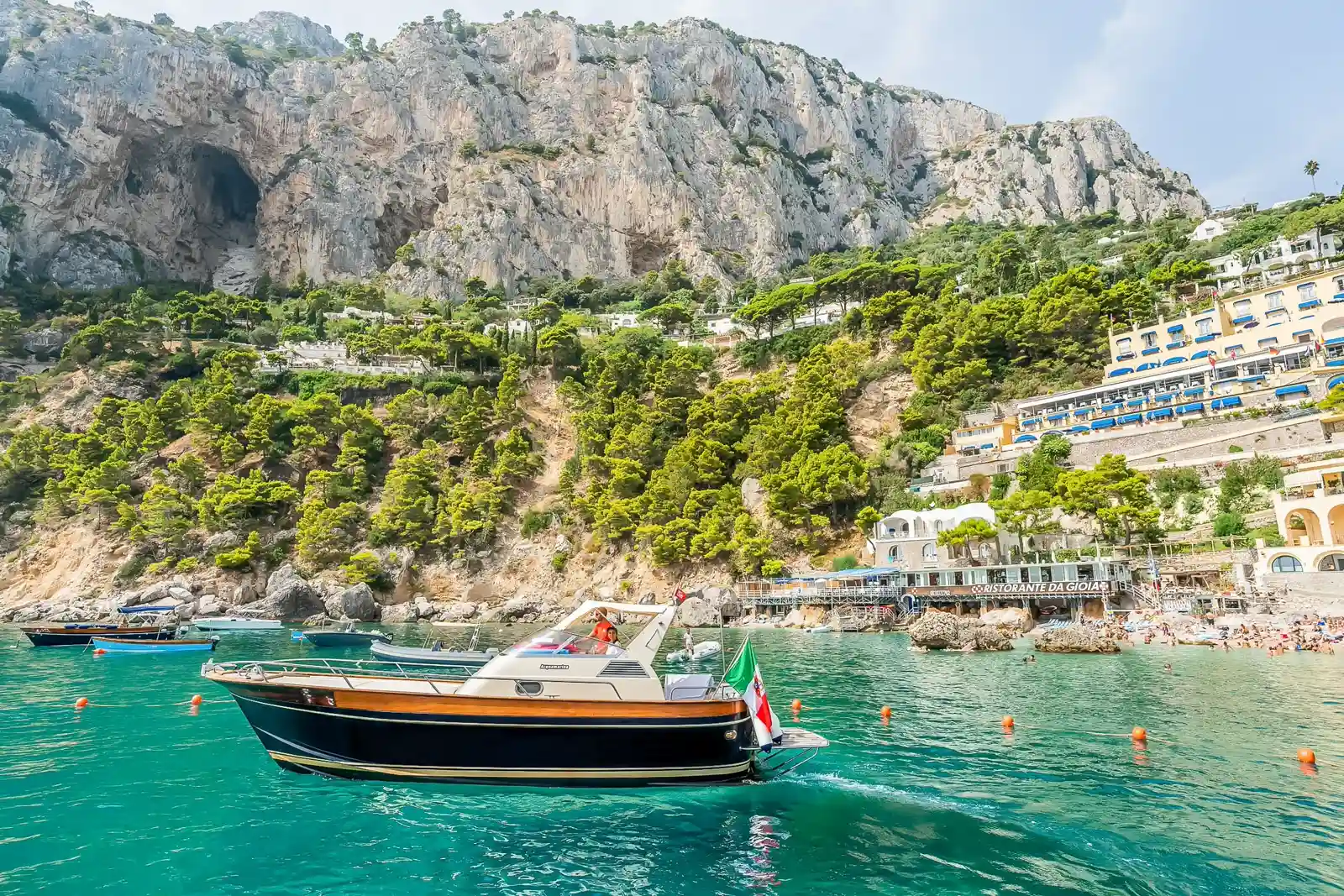
Marina Piccola is the small, glamorous southern bay at the foot of steep cliffs beneath Monte Solaro. It faces south and is shielded from the wind, giving it a warm microclimate and calm, clear water — locals sunbathe here even in midwinter. It looks directly across at the Faraglioni, which makes it the island's most dramatic swimming spot; because it sits under high cliffs, direct sun leaves the bay around 4pm. Its two small free beaches, Marina di Mulo and Marina di Pennauro, are separated by the Scoglio delle Sirene (Sirens' Rock), which local tradition ties to Homer's Odyssey — the rocks where the Sirens sang to lure Ulysses. Around the bay sit historic beach clubs including La Canzone del Mare, founded in 1932 by the British singer Gracie Fields.
Marina Piccola, the sheltered southern bay, is the most common swim stop on the loop.
Swimming Stops: Where You Get in the Water
Most small-group and private tours build in one or two swim stops of 15–20 minutes, at spots the skipper picks according to sea conditions. The usual candidates:
The Faraglioni area — deep, clear water with the stacks looming overhead. From land the beach clubs La Fontelina and Da Luigi sit directly beneath the rocks; from the boat you simply drop anchor nearby.
Marina Piccola coves — shallow, sheltered and clear, with rocks and small fish visible below. The best snorkelling on the loop.
The Green Grotto — where allowed, you swim right through the emerald-lit cave.
Cala di Limmo and Cala del Rio, just past Punta Carena — quieter dips, though you shouldn't linger on the tiny beaches there because of falling rocks.
Capri's water is famously clear, and the sea around the island is excellent for snorkelling. Bring a mask if you can; several tours provide or rent basic gear.
Check live availability — small-group Capri cruise with snorkelling and drinks
There are four broad ways to sail around Capri. The Blue Grotto entry fee of €18 per person is essentially never included in any of them.
Group tours from Capri's Marina Grande. The cheapest option if you're already on the island: the two big operators run continuous departures from their piers, and a standard island loop with the Faraglioni costs about €25 per person for roughly 1¼–2 hours. These are larger boats — in peak summer expect anywhere from a dozen to 80+ passengers.
Boat tours from Sorrento. A full-day tour averages about $125–150 per person and typically includes the crossing, the island circuit with the White, Green and Coral grottoes and the Faraglioni, a swim stop and 3–4 hours of free time ashore. Since a round-trip hydrofoil ticket alone runs about €40, the tour is often good value — see our ferry comparison for the maths.
Private charters. The most flexible option: the boat is yours and you decide where to stop, whether to pass through the arch and whether to attempt the Blue Grotto. Walk-up private tours start around €200 for two hours (per boat, typically up to about seven passengers) and a full-day gozzo with skipper from around €400; bookable private circuits built specifically around the Faraglioni and the sea caves run from about €360 per boat. For four to six people the per-person cost approaches a group tour, with far more freedom.
Renting a boat without a licence. You don't need a licence in Italy for an engine under about 40 HP within 6 nautical miles of the coast. Local operators at Marina Grande rent self-drive boats on the day from around €150 for a 2–4 hour slot (fuel extra, roughly €20–25 for a lap of the island); pre-bookable licence-free rentals are priced per boat for a longer day and start nearer €499 for a 40 HP inflatable carrying up to six. Best only for those with some boating experience — the Bay of Naples is busy and can turn choppy.
If you're weighing formats rather than sights, our boat tours guide compares shared and small-group trips side by side, and the day trip itinerary shows how the loop fits into a single day.
Photography: Best Light & Angles
Morning, east coast: Salto di Tiberio, the White Grotto, Villa Malaparte and the Natural Arch light up best in the first hours of the day, and the sea has a graphic clarity before the day-tripper boats arrive. Early departures also beat the crowds at the Faraglioni arch.
Midday, the grottoes: the light effects inside the Blue and Green grottoes are most intense between roughly noon and 2pm, when the sun is high and underwater refraction is strongest. Unfortunately that's also when Blue Grotto queues peak.
Afternoon, west coast: the western side and Punta Carena come into their own later, ending in a sunset facing Ischia.
The Faraglioni face south and photograph well all day, but soft early or late light flatters portraits most. From a boat, a longer lens (70–200mm) compresses the stacks nicely.
Charge your devices beforehand, and on group boats sit on the side the skipper indicates for the arch pass.
Two hours on the water covers nearly everything that makes Capri legendary.
The Short Version
Capri rewards those who take to the water. A two-hour loop delivers the Faraglioni and their arch, the emerald Green Grotto, the pale chambers of the White Grotto, the cliff-clinging red of Villa Malaparte, the Paleolithic Natural Arch and the wild sweep of coast around Punta Carena — much of it invisible from land. Whether you join a shared tour, splurge on a private charter or captain your own gozzo, seeing the island from the sea is the difference between visiting Capri and understanding it. If you're staying in Sorrento, our Sorrento guide covers what to do around the crossing.
What you'll actually see, answered
Capri Boat Tour Sights: Common Questions
Do Capri boat tours from Sorrento circle the whole island?
Most full-day tours from Sorrento do a complete circumnavigation — roughly 17 km of coastline — taking in the Faraglioni, Villa Malaparte, the White, Green and Coral grottoes and Punta Carena before dropping you at Marina Grande for free time ashore. Shorter afternoon cruises sometimes cover only one side of the island, so check the itinerary if the full loop matters to you. Our tour comparison lists what each format includes.
Can you swim at the Faraglioni?
Yes. Boats anchor near the stacks for swimming, and two beach clubs — La Fontelina and Da Luigi — sit directly beneath them, reached on foot from Belvedere Tragara. The water there is deep and clear.
Can boats go through the Faraglioni arch?
Yes — the arch in the middle stack, Faraglione di Mezzo, is large enough for tour boats to pass through, and doing so with a kiss for luck is the tradition of the trip. In a swell or strong wind the passage becomes unsafe and skippers detour around the outside.
What grottoes can you swim in on Capri?
The Green Grotto is the main swimmable cave, conditions and tour permitting. Swimming is forbidden in the Blue Grotto. The White and Coral grottoes are generally viewed from just outside, sometimes with a short supervised swim.
How long does it take to boat around Capri?
About 90 minutes to two hours for the full loop with photo stops, covering roughly 17 km of coastline. Add time for swim stops or a Blue Grotto attempt.
Is Villa Malaparte open to visitors?
No. It remains privately owned and closed to the public, accessible by invitation only. For visitors it's best seen from the water on a boat tour.
What is the difference between Marina Grande and Marina Piccola?
Marina Grande is the main port on the north coast, where ferries dock and boat tours depart. Marina Piccola is the small, sheltered swimming bay on the south coast, facing the Faraglioni.
See it from the water
Book a Capri Boat Tour from Sorrento
The Faraglioni arch, the Green and White grottoes, Villa Malaparte and Punta Carena — plus swim stops and free time ashore, all in one day.